

The Path
Download on Itch
Concept
The Path is a walking simulator, with strong aesthetic and narrative inspiration from Twin Peaks, and with gameplay focused on Curiosity-Driven Exploration. The player takes on the role of an unnamed character who relives certain memories in order to solve an unsolved case. He will wander through Old Town, an older mining city that hides more than it seems, searching for clues that will eventually lead to the solution of the mystery.
Design Goal
The goal is to create a level design that uses my knowledge of Unreal Engine and the theoretical foundations of Curiosity Driven Exploration. The level design should be an open map where the player can move freely, but the level of programming should be kept very low in order to avoid running into problems I don’t know how to solve.


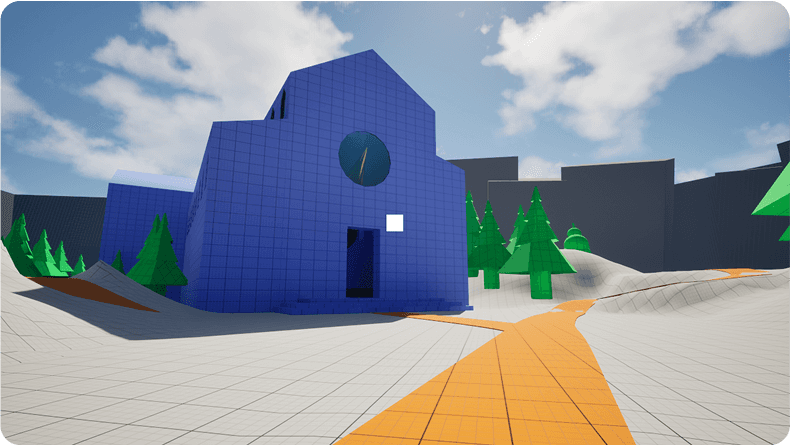


Curiosity is a primary human need: it is a thirst for knowledge that helps reduce uncertainty and maintain control over the surrounding environment.
Curiosity is the result of environmental stimuli that generate desires identifiable as gaps: the difference between what the player knows and what they would like to know, thus creating uncertainty. This sensation, in real life, often takes on a negative connotation due to the risks it entails, but in a game it becomes an opportunity to create unique experiences.
When the player is stimulated by these feelings of uncertainty, it can develop into:
Short-term curiosity, an observation of the environment surrounding the player
Long-term interest, the predisposition of the player to return to what initially sparked their curiosity.
For this reason, exploration should converge on one or more specific topics, so as not to disperse the information that will eventually reward the player.
Multiple topics together form a tentacle-like structure called Reward Learning Framework, which is useful for fueling the behavior of Curiosity-Driven Exploration: this structure can be compared to a feedback loop that pushes the player to seek answers in a Self-Boosted way.
Structure

Peacing
The game features an open map: this structure makes it difficult to establish the player’s direct experience, and therefore challenging to maintain a consistent level of intensity. For this reason, pacing is determined by the player’s level of curiosity, so that it can be fueled when necessary.
At the first start, the player’s interest is minimal, since their basic knowledge of the game is almost low. During the tutorial phase, the player not only gets to familiarize themselves with the main game mechanics, but also begins to learn about the world, sparking curiosity around a first specific topic (in our case, Anna’s disappearance).
This initial peak in the graph is followed by a decrease in intensity due to the vastness of the map, where players can gather various pieces of information, encouraging movement through non-directed exploration. The intensity driven by curiosity rises again when the player uncovers the first surface-level clues, which eventually lead them to one of the secret locations that give meaning to the information collected.
This approach keeps the player’s interest alive, preventing it from fading, as they are driven by the desire to find answers to their questions. However, the player’s interest may drop if the puzzles become too obscure, making their resolution overly frustrating. Intensity reaches its highest point only when the agent manages to obtain all the necessary information to solve the given topic—yet this happens only if the player succeeds in reaching their goal by understanding the clues collected, rather than by chance.
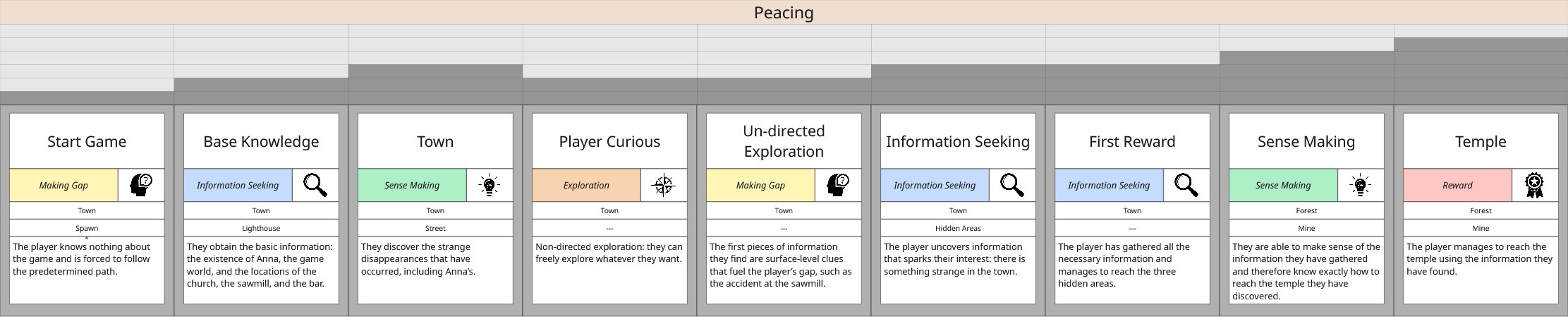
Reward Learning Framework
Each area of the game must contain at least two pieces of information that push the player toward other areas of the map. In this way, the player will have an equal chance of accessing the framework regardless of their initial decision. Additionally, each hidden area that provides context to the information collected must inform the player of the temple’s existence and that it can be accessed from the mines. This ensures it does not matter which area the player discovers first.


Layout
OLD TOWN
Lighthouse - Tutorial


Player

Wall

Information

Critical Path

Terrein

Vegetable

Stairs
The player begins inside the lighthouse area and will be required to explore this initial zone in order to receive the first pieces of information. They will also have the opportunity to gain a complete view of the map, helping them to orient themselves later on, while noticing the presence of several focal points such as the church and the factory. Furthermore, by the end of this area, the player’s curiosity will be drawn to Anna’s disappearance, prompting them to seek out more information about it.
OLD TOWN
Village
Player
Wall
Information
Critical Path
Terrein
Vegetable
Stairs

House
The village is the first area where the player can freely explore. For this reason, a series of pieces of information are provided, such as the accident at the factory, the presence of a citizen considered insane, and the disappearance of another girl. The first location they will visit is the bar, a central element that stands out in the environment and suggests to the player that something useful can be found there. Afterward, depending on their curiosity, the player can decide whether to go right (towards the Forest) or left (towards the Sawmill).

FOREST
Church

Player
Wall
Information
Critical Path
Terrein
Vegetable
Stairs

Locked Door
The forest area consists of three key sections:
Church
Lake
Hidden House
The player will primarily see the lake and the church, and can decide which one to visit first. Behind the church there is a secret passage, accessible only if the player possesses the required information. This passage leads to the Hidden House, where the player can uncover one information that sense-making the exploration.
SAWMILL
Industry
Player
Wall
Information
Critical Path
Terrein

Bridge
Stairs
Locked Door
The sawmill is an area divided in two by a river that carries the logs. Here stands a structure that the player can explore, although they cannot access its interior at first. Upon noticing a hole in the wall (caused by the factory accident), the player will begin to wonder how to get inside. By spotting a tunnel that emerges from the mines, they will realize that they need to enter it in order to reach the roof. Once inside the structure, the player will be rewarded with another piece of information for the main topic.

MINES
Tutorial - Endgame
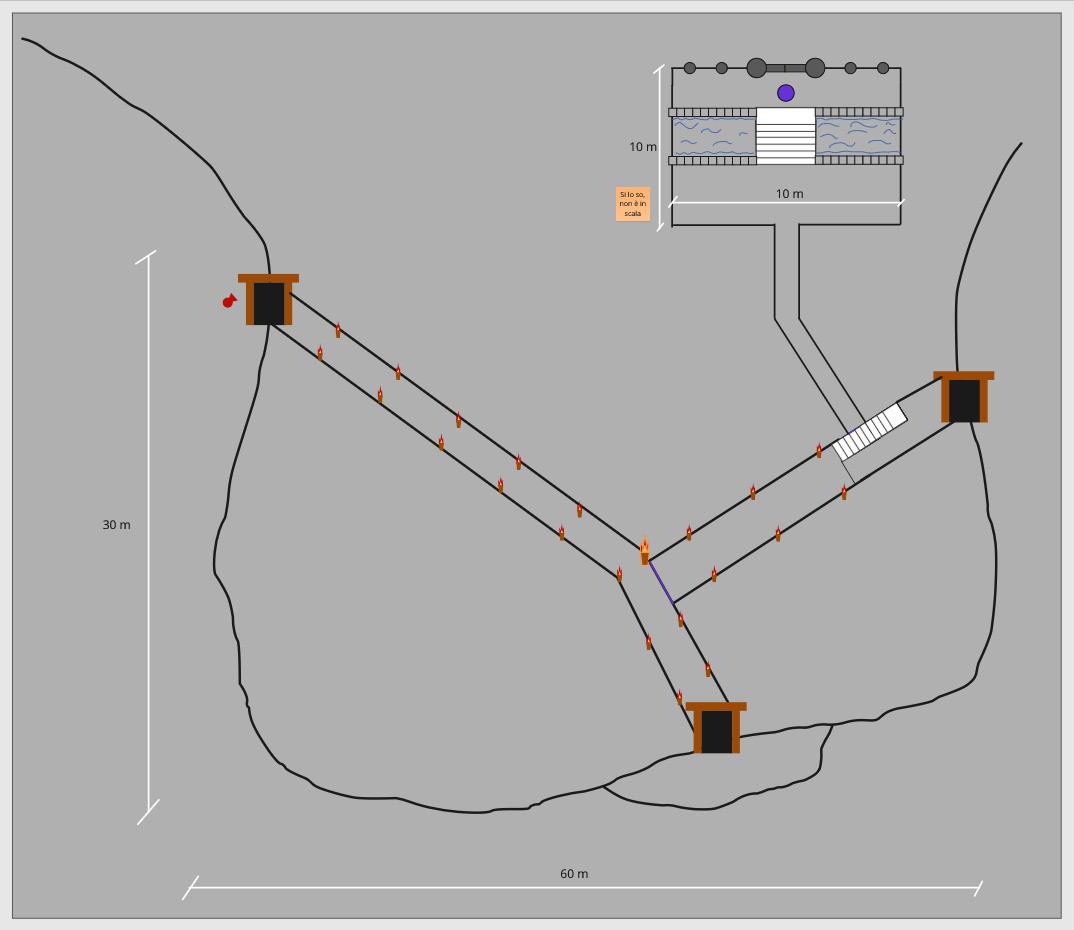
Player

Temple Door

Tourch
Critical Path

Mine

Light Spot
Stairs
Locked Door
The first time, the player can access the mines only through the entrance by the lake. It is only after traversing them and exiting that they will discover the existence of a second entrance, hidden by vegetation behind the bar. Furthermore, if they have noticed the other exit located in the sawmill area, they will start wondering how to reach that spot. At this point, the player will rely on emerging information that will help them unlock the various hidden passages, ultimately leading them to the entrance of the temple.

Alex Artuso
Yo, I'm Alex. An Italian game and level designer passionate about cinema and stories.
Follow Me:


